Quick answer
What size is a China visa photo?
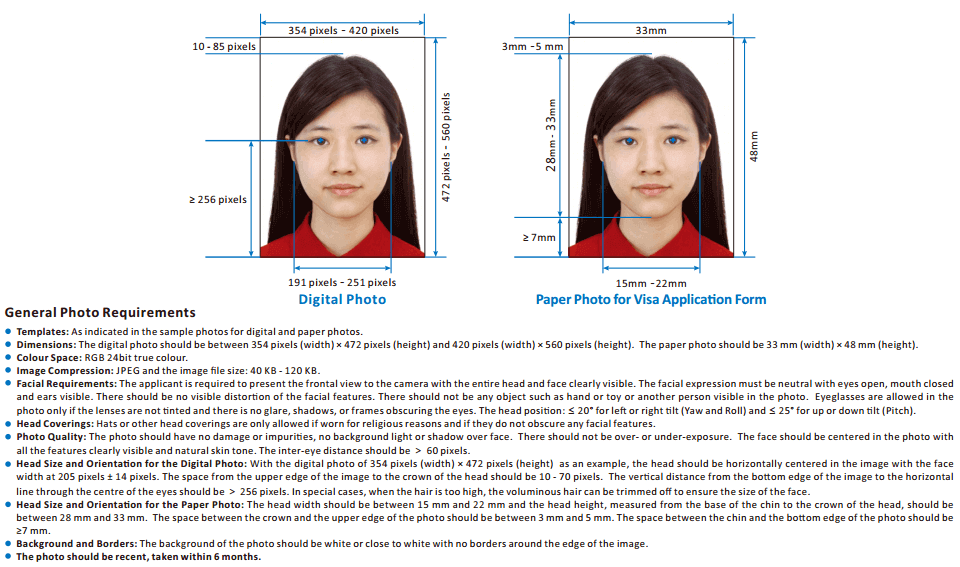
A China visa photo is 33 mm wide and 48 mm high, in colour on a white or near-white background, taken within 6 months, with the head 15–22 mm wide and 28–33 mm high. The digital photo for the online form is a JPEG of 354–420 × 472–560 pixels and 40–120 KB.
A China visa photo (签证照片) is 33 mm wide and 48 mm high, in colour on a white or near-white background with no border, and taken within the last 6 months. Your head must be 15–22 mm wide and 28–33 mm from chin to crown. For the online application form you also upload a JPEG of 354–420 × 472–560 pixels and 40–120 KB.
Most visa applications now start in COVA, the Ministry of Foreign Affairs' China Online Visa Application system. COVA publishes its photo rules as two illustrated requirement sheets, and Chinese visa application service centres repeat the print rules in their FAQs. This guide follows both.
China visa photo size and print rules
| Photo size | 33 mm wide × 48 mm high |
|---|---|
| Head width | 15–22 mm |
| Head height | 28–33 mm, from chin to crown |
| Above the head | 3–5 mm from the crown to the top edge |
| Below the chin | At least 7 mm to the bottom edge |
| Background | White or close to white, with no border |
| Photo age | Taken within the last 6 months |
| Paper | Glossy photo paper, not matte or plain paper, with no stains, scratches or creases |

One printed photo or two?
Visa centres do not agree. The Sydney Chinese Visa Application Service Centre's FAQ (February 2025) says to submit one photo, while a Melbourne centre notice, reposted on its website in August 2026, says applicants must submit two paper photos. Check the checklist of the centre or embassy you are applying to, and bring a second identical print just in case.
Digital photo for the online form
COVA asks for a colour JPEG of 354–420 pixels wide and 472–560 pixels high, 40–120 KB, in 24-bit RGB. It has a built-in crop tool, so you can upload a larger original and crop it in the form. The face-position rules in pixels, and fixes for failed uploads, are on our COVA photo upload page.
Older upload limits
A 2023 visa centre FAQ said the online photo "cannot exceed 354 × 472" pixels. That was the older system. Current COVA requirement sheets give a range of 354–420 × 472–560 pixels, so follow those.
Pose, expression, glasses and head coverings
- Face the camera with your whole head and face in the frame and your head centred. COVA allows no more than 20° of turn or tilt to either side and 25° up or down.
- Neutral expression, eyes open, mouth closed and both ears visible.
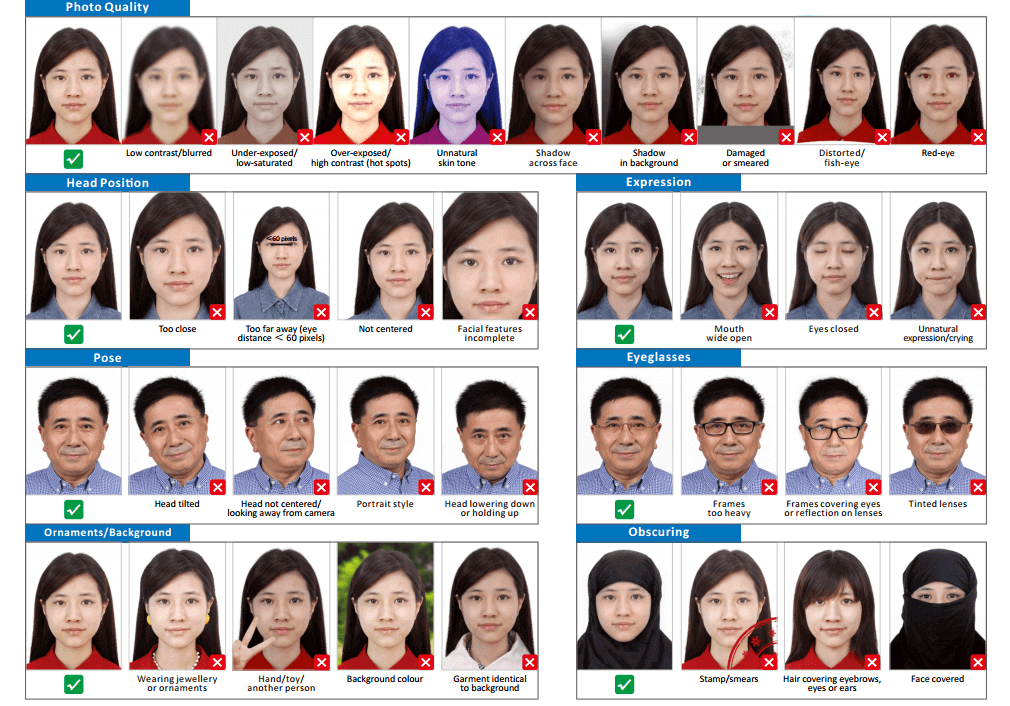
- Glasses are allowed if the lenses are not tinted, there is no glare or shadow, and the frames do not hide your eyes. Visa centres add: no thick-rimmed frames.
- Head coverings are allowed for religious reasons only, with your face fully visible.
- No jewellery or ornaments, and no hands, toys or other people in the photo.
- Natural skin tone and even light: no shadows on your face or the background, no red-eye and no over- or under-exposure.


All the faults COVA lists, and how to fix them
Is a China visa photo 2 × 2 inches?
Not according to any current official source we could find. COVA, the Sydney and Melbourne visa centres and the Chinese Embassy in the US all point to the same 33 × 48 mm rules. An older New York consulate FAQ appears in search results describing a 2 × 2 inch photo, but that page would not load and we could not confirm it. A square 2 × 2 inch photo is the US visa size.
Only use 2 × 2 inch if you are asked
If the embassy, consulate or visa centre handling your application specifically asks for 2 × 2 inches, our linked tool has a square preset. Otherwise use 33 × 48 mm.
Visas and permits issued inside China
If you extend a visa or apply for a residence permit at a public security exit-entry office in China, the photo follows NIA's exit-entry photo standard instead. It uses the same 33 × 48 mm print, but also accepts a light grey or light blue background and a 20–80 KB JPEG. The details are in the Chinese passport photo guide.
Applying for a China visa
The Ministry of Foreign Affairs' visa instructions (August 2026) list the basic documents: the online application form, your passport, a photo, proof of legal stay or residence, and any previous Chinese passport or visa, as your local embassy or consulate requires. You fill in the form and upload documents in COVA, then submit your passport at the embassy, consulate or visa centre when asked. The Chinese Embassy in the US moved to the new COVA system on 30 September 2025.
Holders of D, Q1, S1, X1 and Z visas must apply for a residence permit within 30 days of entering China. Many travellers need no visa at all: see China visa-free entry.
How to get your China visa photo right
- Check whether you need a visa. Ordinary passport holders from 50 countries can visit for up to 30 days visa-free, mostly until 31 December 2026, and 240-hour transit covers 55 nationalities.
- Take the photo on a white background. Face the camera with a neutral expression, eyes open, mouth closed and both ears visible, in even light with no shadows, wearing a dark top.
- Crop it to 33 × 48 mm. Keep your head 28–33 mm from chin to crown and 15–22 mm wide, with 3–5 mm above the crown and at least 7 mm below the chin.
- Save the digital copy for COVA. Upload a JPEG of 354–420 × 472–560 pixels and 40–120 KB, or upload a larger original and use the COVA crop tool. If the file is not a JPG, such as a HEIC photo from an iPhone, convert it with the free 123PhotoTool JPEG converter.
- Print it on glossy paper. Bring the number of prints your visa centre asks for, on glossy photo paper with no stains or creases.
China visa photo FAQ
33 mm wide and 48 mm high, in colour on a white or near-white background, with the head 15–22 mm wide and 28–33 mm from chin to crown. The digital photo for the online form is a JPEG of 354–420 × 472–560 pixels and 40–120 KB.
Not according to any current official source we found. COVA, the visa centres and Chinese embassies all give 33 × 48 mm. A 2 × 2 inch (51 × 51 mm) photo is the US visa size; use it for a China visa only if the office handling your application asks for it.
It depends on the visa centre. The Sydney centre's FAQ says one photo, while a Melbourne centre notice (reposted on its website in 2026) says two paper photos. Check your centre's checklist, and bring a spare.
Yes, if the lenses are not tinted, there is no glare or shadow and the frames do not hide your eyes. Visa centres also say no thick-rimmed frames.
No. Keep a neutral expression with your eyes open and mouth closed, and make sure both ears are visible.
Maybe not. Ordinary passport holders from 50 countries can stay up to 30 days visa-free, mostly until 31 December 2026, and 55 nationalities can use 240-hour visa-free transit. See visa-free entry.
Official sources
- Ministry of Foreign Affairs: China Online Visa Application (COVA), photo requirements
- China Consular Services: Visa Application Instructions (August 2026)
- Chinese Visa Application Service Centre, Sydney: photo FAQ
- Chinese Visa Application Service Centre, Melbourne: photo notice (Chinese, reposted 2026)
- Chinese Embassy in the US: Requirements and Procedures for Chinese Visa Application
- National Immigration Administration: 出入境证件相片照相指引 (exit-entry photo guide)
Last checked . Requirements and fees can change, so always confirm with the issuing agency before you apply. This site is independent and not affiliated with any government agency.