Quick answer
What size is a Chinese passport photo?
A Chinese passport photo is 33 mm wide and 48 mm high, in colour and taken within 6 months. Abroad, the Ministry of Foreign Affairs asks for a white background, a head 28–33 mm high and a JPEG of 30–80 KB. In China, the NIA standard also allows light grey or light blue backgrounds.
A Chinese passport photo (护照照片) is a 33 × 48 mm colour photo, taken within the last 6 months, showing your whole face and both ears with a natural expression. Two official specs apply: the National Immigration Administration (NIA) standard when you apply in China, and the Ministry of Foreign Affairs (MFA) e-passport spec when you apply abroad in the 中国领事 app, which asks for a white background, a head 28–33 mm high and a 30–80 KB JPEG.
Both specs are based on the same international passport photo standard (ICAO Doc 9303), so a good studio photo on a white background normally passes either. The details below come from NIA's exit-entry photo guide 《出入境证件相片照相指引》, NIA's passport service guide and the MFA's e-passport photo specification.
Chinese passport photo size: in China and abroad
The print size is the same everywhere, but NIA and the MFA measure the head slightly differently, so their numbers do not match exactly. A head about 30 mm high and 18–20 mm wide sits inside both ranges.
| Rule | Applying in China (NIA) | Applying abroad (MFA, 中国领事 app) |
|---|---|---|
| Photo size | 33 × 48 mm | 33 × 48 mm |
| Head height | 30–34 mm, crown to chin | 28–33 mm, chin to crown |
| Head or face width | Face 16–24 mm wide | Head 15–22 mm wide |
| Space above the head | 1–3 mm above the crown, inside a 30 × 40 mm "effective area" | 3–5 mm from crown to top edge |
| Space below the chin | Not stated separately | At least 7 mm |
| Background | White, light grey or light blue | White |
| Digital file | JPEG, 24-bit colour, 20–80 KB | JPEG, 30–80 KB |
| Photo age | Within 6 months | Within 6 months |

NIA's guide draws a 30 × 40 mm "effective area" (相片有效区域) inside the 33 × 48 mm print and measures the head within it. It also marks an eye zone 14–22 mm below the top of that area for adults, and 14–26 mm for children.
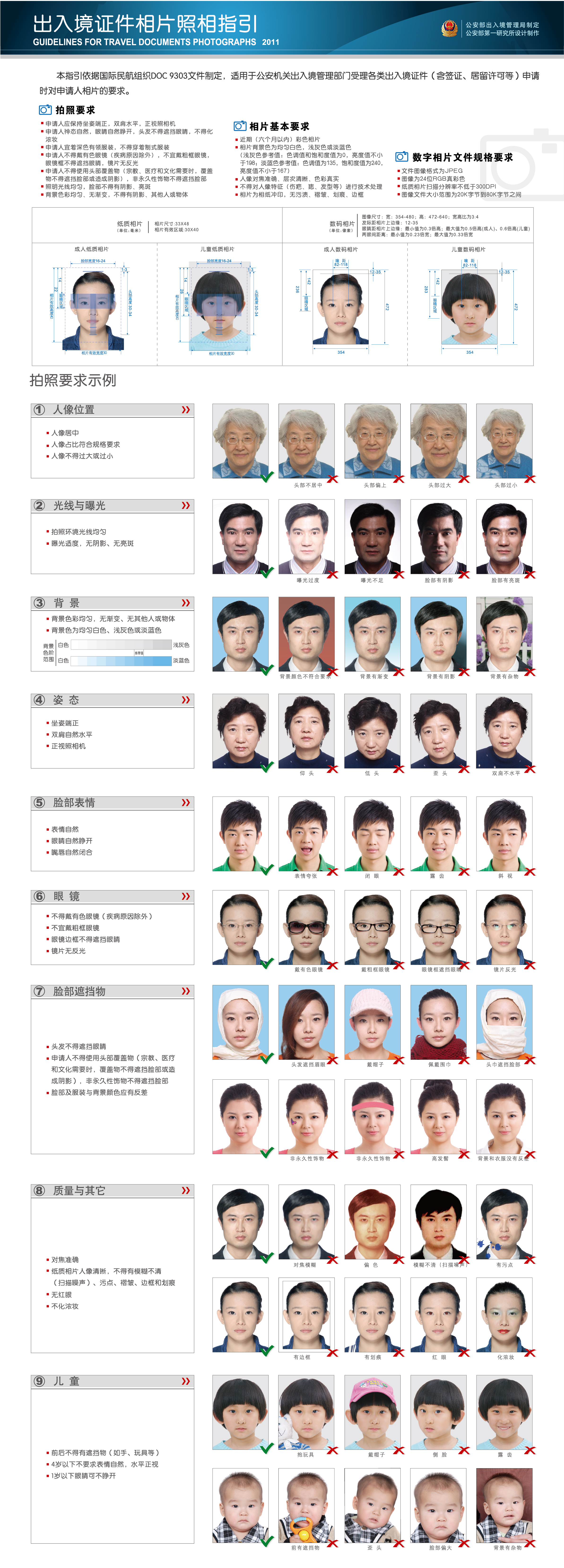
Digital photo rules
Most offices in China work from a digital file. In practice an approved studio or police photo point usually captures it and gives you a photo receipt (回执). NIA's guide sets these limits for the file:
| Pixel size | 354–480 px wide × 472–640 px high, 3:4 ratio |
|---|---|
| Format | JPEG, 24-bit RGB colour |
| File size | 20–80 KB (NIA); 30–80 KB for the MFA e-passport spec |
| Top of head | 12–35 px below the top edge |
| Eyes | Between 0.3 and 0.5 of the image height from the top (up to 0.6 for children) |
| Distance between the eyes | 0.23–0.33 of the image width, which is 82–118 px on a 354 px wide photo |
| Scans of prints | At least 300 dpi |
Which spec applies to you?
In mainland China, passports are issued by public security exit-entry offices under NIA, so the NIA standard applies. It also covers Hong Kong and Macau permits, Taiwan travel permits and visas and residence permits issued in China. Abroad, you apply in the 中国领事 app and the MFA e-passport spec applies: see renewing a passport abroad.
Pose, expression and clothing
- Sit upright with your shoulders level and face the camera directly. Do not tilt, raise or lower your head.
- Natural expression, eyes open, mouth closed. NIA lists showing teeth and exaggerated expressions as faults.
- Keep your face, eyebrows and ears clear. Hair must not cover your eyebrows or eyes, and the MFA lists hair over the ears as a fault. NIA also rejects a high bun (高发髻) on top of the head.
- Wear dark clothes with a collar that contrast with the background. No uniforms. A top the same colour as the background is a listed fault.
- No heavy make-up, and no non-permanent ornaments, such as face stickers, covering your face.
- Only you in the photo, with no other people or objects. For babies, see baby and child photos.
Glasses and head coverings
Do
- Wear clear glasses if you need them, with no glare and frames clear of your eyes
- Wear a head covering for religious, medical or cultural reasons, with your whole face visible
- Wear hearing aids if you need them: the MFA spec allows them
Don't
- Wear tinted or coloured lenses (NIA allows them only for an illness)
- Wear thick or heavy frames, or frames that cover your eyes
- Wear a hat, headband or scarf for any other reason, or let a covering shade your face
Take your glasses off if you can
Glasses are allowed by the rules, but glare and frame shadows are among the most common faults. Some embassies tell 中国领事 app users not to wear glasses at all, so removing them avoids a resubmission.
Background, light and editing
Do
- A plain, evenly lit background with no gradient, shadow or objects
- Even light on your face, sharp focus and natural skin tone
- Printed photos on photo paper, free of stains, creases and scratches
Don't
- Shadows or bright spots on your face
- Retouching scars, moles or your hairstyle, or using beautifying apps
- Borders, red-eye, blur, colour casts or scanning noise
NIA defines its two extra background colours precisely: light grey with no colour and a brightness of at least 198, and light blue with hue 135, saturation 240 and brightness of at least 167 (on the Windows colour scale). If you are not sure your wall qualifies, use white, which every spec accepts.
Sample photos


See all correct and incorrect sample photos
How to get a Chinese passport photo
- Check where you are applying. In mainland China you apply at a public security exit-entry office, which follows the NIA standard. Abroad you apply in the 中国领事 app, which follows the MFA spec with a white background.
- Get the photo taken. In China, most offices want a photo receipt from an approved studio or police photo point. Abroad, embassies recommend a photo studio, or ask someone to take the photo against a plain white wall.
- Check it against the rules. Natural expression, eyes open, mouth closed, ears and eyebrows visible, dark collared top, even light, no tinted lenses or glare, and no retouching.
- Crop it to 33 × 48 mm. Keep the head 28–33 mm from chin to crown and 15–22 mm wide, with 3–5 mm above the crown and at least 7 mm below the chin.
- Submit it with your application. Give the receipt number or photo to the exit-entry office, or upload the JPEG in the 中国领事 app and continue to the next step. If the file is not a JPG, such as a HEIC photo from an iPhone, convert it with the free 123PhotoTool JPEG converter.
Check the file size before you upload
Our linked photo tool makes a 33 × 48 mm print and a 385 × 560 pixel file. The MFA spec asks for a 30–80 KB JPEG, so check the saved file size before uploading it to the 中国领事 app.
Applying in China: fees and timing
| Where | In person at a county-level or higher public security exit-entry office (under-16s with a guardian) |
|---|---|
| What to bring | A photo to the NIA standard, the application form and your resident ID card |
| Fingerprints | Taken from everyone aged 16 or over; optional for under-16s with a guardian's consent |
| Fee | 120 yuan per passport |
| Processing | 7 working days where your household registration (户籍) is; 20 days if you apply in another province; 5 working days for listed urgent reasons |
| Validity | 10 years from age 16; 5 years under 16 |
From NIA's ordinary passport service guide. In 50 pilot cities, residents aged 16 or over can also renew or replace a passport fully online since 20 November 2025, uploading a digital ID photo: see photo receipts and online renewal.
Chinese passport photo FAQ
33 mm wide and 48 mm high, in colour. For applications abroad, the Ministry of Foreign Affairs wants the head 28–33 mm from chin to crown and 15–22 mm wide. NIA's guide for photos taken in China measures the face at 16–24 mm wide and the head at 30–34 mm high.
White is accepted everywhere. NIA's exit-entry photo standard, used for passports issued in China, also accepts light grey or light blue. The Ministry of Foreign Affairs spec for passports issued abroad asks for white only.
Yes, if the lenses are clear, there is no glare and the frames do not cover or blur your eyes. NIA advises avoiding thick frames. Some embassies tell app users to take glasses off, which is the safest choice. See the FAQ.
Taken within the last 6 months, under both the NIA standard and the Ministry of Foreign Affairs spec.
Usually you bring a photo receipt (回执) instead: an approved studio or police photo point uploads your photo and gives you a receipt or receipt number. Practice varies by city, so check with your office. See photo receipts.
A passport photo has the same 33 × 48 mm size as a China visa photo, but the ID card uses a smaller 26 × 32 mm photo, and many foreign visas use 35 × 45 mm. Compare them in the photo size chart.
No. NIA says features such as scars, moles and hairstyle must not be retouched, and the Ministry of Foreign Affairs bans editing and composite photos. Shanghai police also ban beautifying apps.
Official sources
- National Immigration Administration: 出入境证件相片照相指引 (exit-entry photo guide)
- National Immigration Administration: 普通护照签发服务指南 (ordinary passport service guide)
- Ministry of Foreign Affairs, China Consular Services: 电子护照人像照片规格要求 (e-passport photo specification)
- China Consular Services: 护照/旅行证 (passports and travel documents abroad)
- National Immigration Administration: Notice No. 4 of 2025 (online renewal in 50 cities)
- Shanghai Public Security Bureau: 证件照片采集 (ID photo capture rules)
Last checked . Requirements and fees can change, so always confirm with the issuing agency before you apply. This site is independent and not affiliated with any government agency.