Chinese Passport and Visa Photo Examples

Sample photos showing correct and incorrect photos for Chinese passports, China visas and other exit-entry documents, with the rule behind each one.

Based on official sources · last checked

Quick answer

What does a correct Chinese passport photo look like?

A correct photo shows only you, facing the camera with a natural expression, eyes open and mouth closed, ears and eyebrows visible, in even light on a plain white background, wearing a dark top that contrasts with it. There are no shadows, tinted lenses, glare, jewellery or retouching.

A correct Chinese passport or visa photo is 33 × 48 mm, taken within 6 months, on a plain white background, with your head 28–33 mm high (MFA and COVA) or 30–34 mm (NIA). You face the camera with your eyes open, mouth closed, both ears visible and a dark top. The examples below show what passes and what fails.

The examples are our own AI-generated photos, based on the rejection sheets published by COVA (the MFA's online visa system), the MFA's e-passport photo spec and NIA's exit-entry photo guide. Each caption gives the rule behind it.

Correct examples

These four photos would be accepted, but note the limits in each caption: the light grey background works only for documents issued in China.

Correct photo example
Correct: Correct White background, head straight and centred, natural expression, eyes open, mouth closed, both ears visible and even light.
Correct photo example: clear glasses
Correct: Clear glasses Allowed by the MFA, COVA and NIA rules if the lenses are clear, there is no glare and the frames do not cover your eyes. Some embassies ask you to remove them.
Correct photo example: religious head covering
Correct: Religious head covering Allowed for religious reasons, and under the NIA and MFA passport rules for medical or cultural needs, if your whole face is visible and unshadowed.
Correct photo example: light grey (in China)
Correct: Light grey (in China) NIA's exit-entry standard accepts white, light grey or light blue for documents issued in China. Visa and consular photos need white.

Make passport photo

Background, light and clothing

COVA and the MFA's app photo spec need a white background. NIA also accepts light grey or light blue for documents issued in China, but never a strong colour or a gradient.

Rejected photo example: coloured background
Incorrect: Coloured background COVA visa photos and consular e-passport photos need a white or near-white background. Bright blue or red ID-photo backgrounds fail.
Rejected photo example: white top on white
Incorrect: White top on white COVA and NIA reject clothing the same colour as the background. Wear a dark top, ideally with a collar.
Rejected photo example: shadow on face
Incorrect: Shadow on face Uneven light leaves one side of the face dark and casts a shadow on the background. Both are listed rejection reasons.
Rejected photo example: under-exposed
Incorrect: Under-exposed Photos that are too dark lose facial detail. Face a window or use soft, even light.

Glasses

Clear glasses are allowed under all three official specs, but these faults are among the most common reasons for a retake.

Rejected photo example: glare on glasses
Incorrect: Glare on glasses Reflections on the lenses hide your eyes. Move the light, tilt the glasses slightly or take them off.
Rejected photo example: tinted lenses
Incorrect: Tinted lenses Sunglasses and tinted lenses are not allowed. NIA makes an exception only when they are needed for an illness.
Rejected photo example: heavy frames
Incorrect: Heavy frames Frames must not cover the eyes, and NIA advises avoiding thick-framed glasses altogether.

When in doubt, take them off

Some Chinese embassies tell 中国领事 app users not to wear glasses at all. Removing them avoids glare, frame shadows and a second attempt.

Face, hair and jewellery

Rejected photo example: teeth showing
Incorrect: Teeth showing Keep a natural expression with your mouth closed. NIA lists showing teeth and exaggerated expressions as faults.
Rejected photo example: head tilted
Incorrect: Head tilted Keep your head level and face the camera. COVA allows no more than 20° left or right and 25° up or down.
Rejected photo example: hair over eyes
Incorrect: Hair over eyes Hair must not cover your eyebrows or eyes. Pin it back off your face.
Rejected photo example: ears covered
Incorrect: Ears covered COVA wants both ears visible, and the MFA lists hair over the ears as a fault. Tuck your hair behind your ears.
Rejected photo example: earrings
Incorrect: Earrings COVA lists jewellery and ornaments as a fault, and some embassies ask for no jewellery at all. Take them off.
Rejected photo example: hand in the photo
Incorrect: Hand in the photo Nothing may appear in front of the face or body: NIA and COVA reject hands, toys and other people in the photo.

Head size and image quality

On the 33 × 48 mm print, the MFA and COVA ask for a head 28–33 mm high and 15–22 mm wide, with 3–5 mm above the crown and at least 7 mm below the chin. NIA measures it differently: a head 30–34 mm high and a face 16–24 mm wide.

Rejected photo example: head too small
Incorrect: Head too small On a 33 × 48 mm print the head must be 28–33 mm high from chin to crown, under the MFA and COVA rules.
Rejected photo example: head too big
Incorrect: Head too big Leave 3–5 mm between the top of your head and the top edge, and at least 7 mm below your chin.
Rejected photo example: blurred
Incorrect: Blurred The photo must be sharp and in focus, without heavy compression or scanning noise.

Every fault in the official lists, and how to fix it

Which rules apply to you?

Which photo specification applies to each Chinese document
DocumentSpecBackground
China visa (applied for abroad)COVAWhite or near-white
Chinese passport, applied for abroadMFA e-passport specWhite
Chinese passport, HK/Macau or Taiwan permit, applied for in ChinaNIA exit-entry standardWhite, light grey or light blue
Residence permit or visa issued in ChinaNIA exit-entry standardWhite, light grey or light blue
NIA exit-entry photo guide in Chinese, drawn up in 2011 by the Ministry of Public Security exit-entry administration: shooting requirements, basic photo requirements and the digital file specification; size diagrams for adult and child paper photos and digital photos; and ticked and crossed example photos for head position, light and exposure, background, posture, expression, glasses, face coverings, quality, and children
NIA's exit-entry photo guide (出入境证件相片照相指引): size layouts for adults and children, and correct and incorrect examples for each rule Image: National Immigration Administration (NIA) · View the original
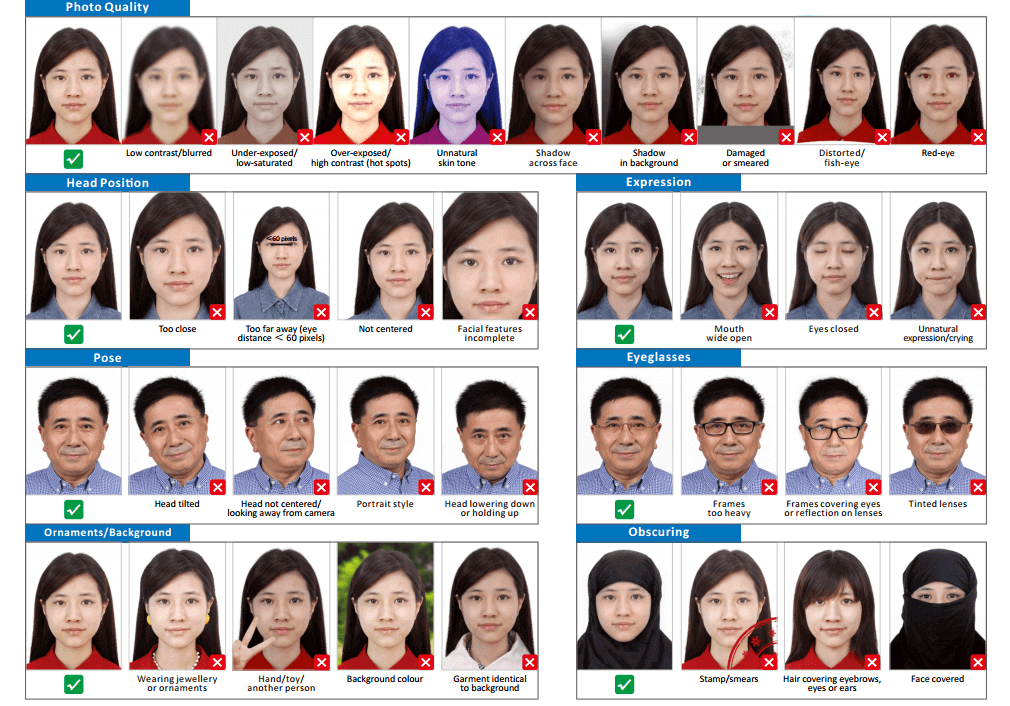
COVA photo examples, each group starting with an accepted photo: photo quality (low contrast or blurred, under-exposed, over-exposed or hot spots, unnatural skin tone, shadow across the face, shadow in the background, damaged or smeared, distorted or fish-eye, red-eye); head position (too close, too far away with the eyes less than 60 pixels apart, not centred, facial features incomplete); expression (mouth wide open, eyes closed, unnatural expression or crying); pose (head tilted, head not centred or looking away, portrait style, head lowered or raised); eyeglasses (heavy frames, frames covering the eyes or reflections, tinted lenses); ornaments and background (jewellery, a hand, toy or another person, background colour, garment the same colour as the background); and obscuring (stamp or smears, hair over the eyebrows, eyes or ears, face covered), with a religious head covering shown as accepted
COVA's accepted and rejected photo examples Image: China Online Visa Application (COVA), Ministry of Foreign Affairs of China · View the original

How to check your photo against the examples

  1. Check the background. Make sure the background is plain white (or, for documents issued in China, light grey or light blue), with no shadow or gradient.
  2. Check your face and ears. Look for a straight head, eyes open, mouth closed, and both ears and eyebrows clear of hair.
  3. Check glasses and clothing. Look for glare, tinted lenses or heavy frames, and make sure your top is dark rather than white.
  4. Check the head size. Measure from chin to crown on the 33 × 48 mm crop: 28–33 mm for COVA and MFA photos, 30–34 mm for NIA.

Photo examples FAQ

No. They are our own AI-generated images of people who do not exist, in the 33 × 48 mm shape, to show each rule clearly. The official example images also shown on this page are reproduced unaltered from NIA and COVA, with credit and a link to each original. The official sources are listed below.

Only for documents issued in China under NIA's exit-entry standard, such as a passport, HK/Macau permit or residence permit applied for at a public security exit-entry office. Visa photos for COVA and e-passport photos for the 中国领事 app need white.

The MFA, COVA and NIA rules allow clear lenses with no glare and frames that do not cover the eyes. NIA advises avoiding thick frames, and some embassies tell 中国领事 app users not to wear glasses at all.

COVA and NIA reject clothing the same colour as the background, because your shoulders blend into it. Wear a dark top, ideally with a collar.

No. Keep a natural expression with your mouth closed. NIA lists teeth showing and exaggerated expressions as faults, and COVA lists a wide-open mouth and an unnatural expression.

Was this guide helpful?

No ratings yet. Be the first to rate this guide.

Rate this guide from 1 to 5 stars

Official sources

Last checked . Requirements and fees can change, so always confirm with the issuing agency before you apply. This site is independent and not affiliated with any government agency.